
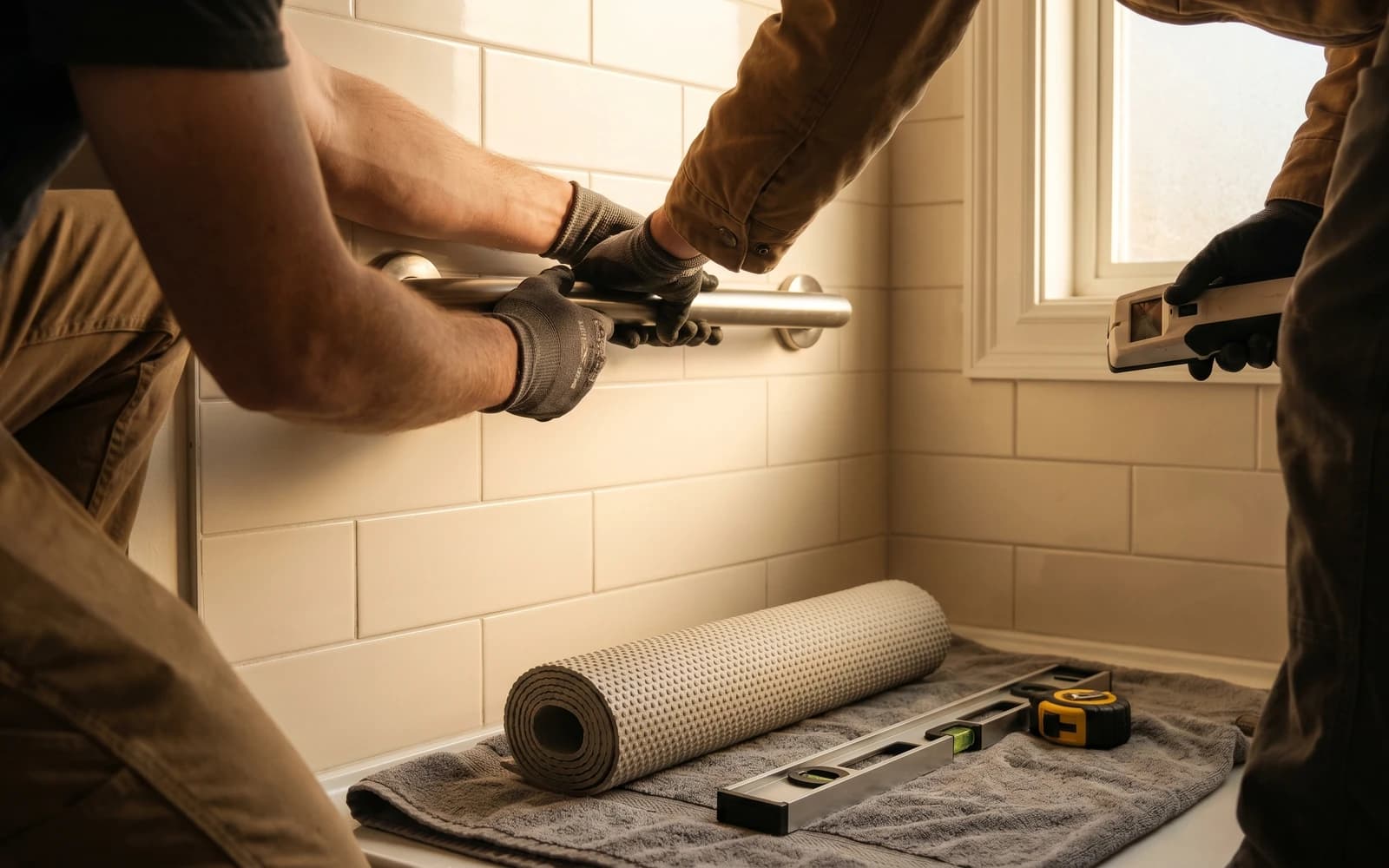
Bathrooms are one of the highest-risk rooms for aging homeowners: wet floors, slippery tubs, awkward thresholds, and nowhere solid to grab during a stumble. This guide is for adult children helping parents stay independent, or homeowners thinking ahead about their own home. All five upgrades below sit inside my home safety service.
1. Grab bars in the right places
Two grab bars matter most: one inside the shower or tub for steadying while showering, and one beside the toilet for sitting and standing. Both need proper anchoring. Decorative bars screwed into drywall alone are not safety equipment.
2. Non-slip surface in the tub or shower
A non-slip mat with suction cups or a peel-and-stick textured strip gives the tub or shower floor more grip when wet. It is a small upgrade, but it removes one of the most common bathroom hazards.
3. Higher toilet seat
Standard toilets sit about 15 inches high. Comfort-height toilets sit 17 to 19 inches, much easier on knees and hips. The replacement is straightforward. Or for a no-replacement option, a raised toilet seat clamps onto the existing bowl.
4. Better lighting
Many bathrooms are lit by a single overhead fixture that casts shadows in the worst places. Add a second light source above the vanity mirror and a small night light at floor level for middle-of-the-night trips. Dimmer-equipped LED bulbs let the user adjust intensity.
5. Lever-style faucet handles
Round knob faucets are surprisingly hard for arthritic hands. Lever handles are easier to operate without grip strength, and older bathrooms often still have round knobs worth swapping.
Every job I take gets a written scope before I start, so the price is agreed in advance and the list stays the list.
