
Most fence questions I get start with the same worry. Is this a patch, or does the whole thing come out? The answer usually lives in one part of the fence, and you can check it yourself before anyone quotes. This guide covers what to look at, what moves the price, and the bylaw rules to know before a new fence goes up.
Push on the posts first
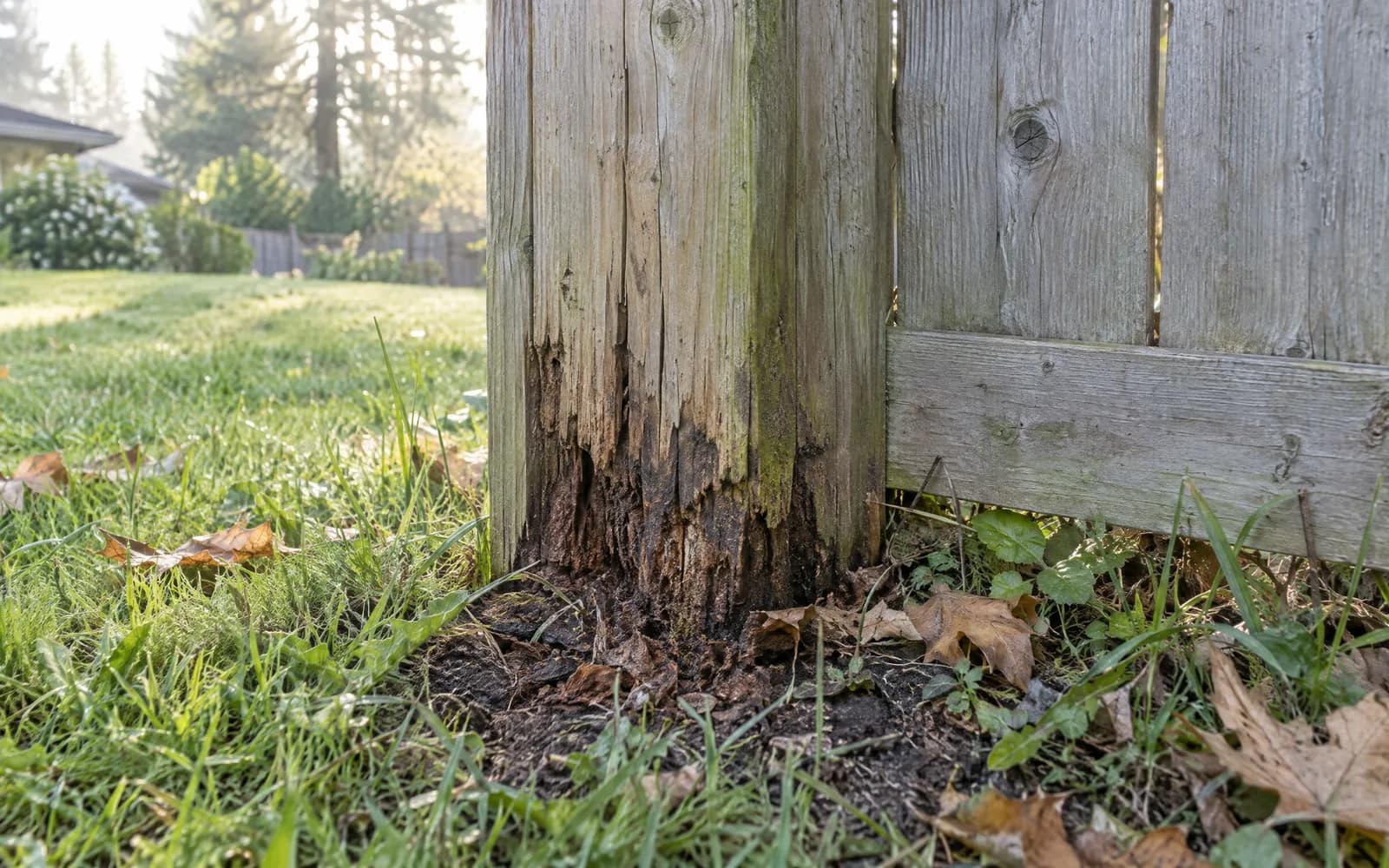
The posts are the spine of the fence, so that is where I start. Grab a post near the top and give it a firm push. Then look at where it meets the ground. A post that holds firm with clean wood at the base is doing its job, even if the boards on it look tired. A post that wobbles, or takes a screwdriver at soil level, has lost its strength. New boards will not fix that. On our coast, posts almost always fail at the soil line, where you cannot see it from the yard.
What drives fence repair or replacement cost
- Linear feet of fence, since a short side yard and a full property line are very different jobs
- Number of posts involved, because each post that has to be dug out and reset is real labour
- Whether the posts are rotted at the base, or only the pickets and rails have failed
- Cedar or pressure-treated lumber, which changes both the material cost and the look
- Gate rebuilds, which carry hardware and squaring work that a straight run does not
- Removal and disposal of the old fence, including hauling and dump fees
- Sloped ground, or a tight side yard that limits how lumber and tools get in
- Height and property-line rules, which set how tall the new fence can be
When a repair is the right call
If the posts are sound and the trouble is cracked pickets, a sagging rail, or a section knocked loose in a windstorm, that is a repair. Swapping boards, fixing a rail, or resetting one leaning post costs far less than a rebuild. It also leaves you with a fence that matches the rest of the run. Plenty of fences that look finished only need the failed pieces replaced and the line squared up again.
When to replace instead of repair
Once several posts have rotted through at the base, or a run leans no matter how you prop it, patching stops making sense. You would be paying for repairs again and again on a fence that keeps failing somewhere new. New posts set properly give you a fence that stands straight for years. The same logic drives a deck repair or replacement call: fix isolated damage, and replace once the structure itself is gone.
Do I need a permit to replace a fence in Langley, Surrey or Abbotsford?
For a normal backyard fence, no. The Township of Langley, the City of Langley, Surrey and Abbotsford all leave fences out of what needs a building permit. What each one does set is a height limit. Your new fence has to meet it, even if the old one did not. Here is what each bylaw says, checked in September 2026.
- Township of Langley: on residential lots, 1 m inside the front yard setback and near a street corner, and 2 m everywhere else (Zoning Bylaw 2500, section 111.6). The Township's building bylaw does not count a fence as a structure.
- City of Langley: fences on residential lots can be up to 2.0 m, with much lower limits near a street corner (Zoning Bylaw No. 3300, adopted March 9, 2026). Its building bylaw does not count a fence as a structure.
- Surrey: the city says a building permit is not required for a fence. The zoning bylaw caps residential fences at 1.8 m, and at 1.2 m in a required front yard or street-side yard (Zoning By-law 12000, Part 4, section 23).
- Abbotsford: no permit for the fence itself. On most residential lots the cap is 1.2 m in the front yard and along a street, and 1.8 m on side and rear lines next to a neighbour, park or lane (Zoning Bylaw 2014, section 140).
Two things catch people out. In Surrey and Abbotsford, a fence built on top of a retaining wall counts the wall in its height. And corner lots have a sight triangle near the intersection where tall fences are not allowed. Surrey also says it has no say in fence disputes between neighbours, so agree on the line and the cost in writing before a shared fence goes up. If you do not know your zone, the planning desk at your city can tell you. For the full height rules, including front yards, corner lots, lattice toppers and White Rock, see how high a fence can be in Langley, Surrey and Abbotsford.
I check the rules for your address before I set a new post, because they do change. The City of Langley replaced its whole zoning bylaw in March 2026. When I quote fence repair in Langley or fence repair in Surrey, the height goes in the written scope.
Long fence lines on acreage: Aldergrove, Abbotsford and rural Langley
A fence on acreage is a different job from a backyard fence. The run is long, the posts are many, and the line often crosses wet ground far from the house. The repair-or-replace test is still the posts. The difference is scale. One rotten post in a city yard is a small fix. Twenty along a field line is a plan, and it usually makes sense to replace the worst stretch and repair the rest.
- How long the line is, and how many posts are loose or soft at the ground
- Whether a truck can drive along the line, or lumber has to be carried in
- Wide gates for equipment, which need stronger posts and heavier hardware
- Whether animals need to stay contained while a section is open
- Power and water at the work spot, since a far corner of the property often has neither
The rules loosen on farm and country land. Abbotsford sets no fence height chart for its A, RR, CR and SR zones. The Township's height limits are written for residential zones, and Aldergrove sits inside the Township, so on rural-zoned land ask the Township what applies to your lot. Barbed wire is allowed in the Township's rural (RU) and suburban (SR) zones and in Abbotsford's A, RR and CR zones, but not on regular residential lots.
Acreage lines are part of my fence and deck repair in Aldergrove and fence repair in Abbotsford work. Send photos of the worst posts and a rough length of the line in the quote form. Say how far the line is from the house and whether there is power nearby, and I come prepared.
Every job I take gets a written scope before I start, so the price is agreed in advance and the list stays the list.
Want me to take this one on? My page on fence and deck repair covers what the visit includes, what I hand off, and how I price it.
The wet-coast reason posts fail
Cedar is the classic Lower Mainland fence wood, and it earns that. But our climate is hard on it in one spot. Where the wood meets damp soil, cedar greys and slowly rots, while the parts up in the air still look fine. That is why the posts, not the boards, decide most of these jobs. Keep soil and mulch from piling against the base, and wash the fence when it gets grimy. Both slow the decay. My guide on when to pressure wash covers how often that is worth doing.
Repair or replace, the next step is the same. Send photos of the full run and any leaning posts through the quote form, and I reply in writing with a real number and a plan. The full scope is on the fence and deck services page. If you are weighing a longer list of aging items, the repair-or-replace decision guide lays out the test I use.