
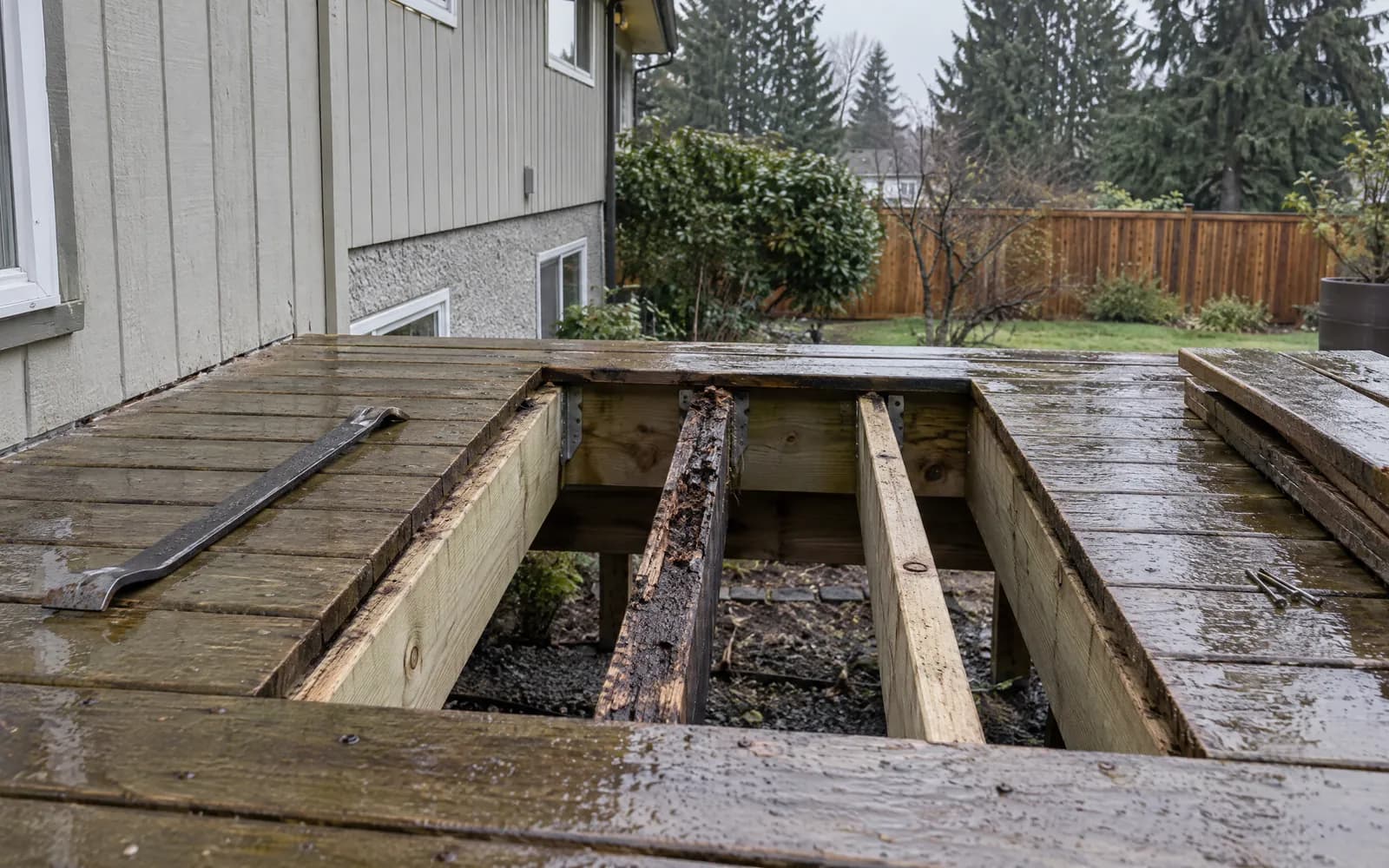
A tired-looking deck and an unsafe deck are two different things, and telling them apart is the whole job. Two decks can look the same from the kitchen window. One needs a weekend refinish and the other needs its framing rebuilt. The difference lives underneath, so that is always where I start.
Assess the structure before the surface
Before I judge a single board, I look at what holds the deck up. That means the posts down to the footings, the beams they carry, the joists between them, and the ledger board. The ledger is the board bolted to the house. It carries the load back into the building, so it is the most important connection on the whole deck. If the framing is solid, almost everything above it can be fixed. If the framing is failing, no amount of surface work makes the deck safe.
Every job I take gets a written scope before I start, so the price is agreed in advance and the list stays the list.
Want me to take this one on? My page on fence and deck repair covers what the visit includes, what I hand off, and how I price it.
Surface issues mean repair or refinish
When the frame checks out, the rest is upkeep. Splintered or grey boards, a railing that has worked loose, chipped stain and popped screws are repair-and-refinish problems. A few boards can be swapped, fasteners reset, and the surface brought back with a proper wash, sand and stain. If your deck is sound and just looks rough after winter, my guide on when to stain or refinish a deck walks through that work and its timing.
Rot in the frame means a rebuild
The picture flips once the framing itself is failing. Joists soft enough to push a tool into, rot spreading through the ledger, posts crumbling at the base, or a guardrail that flexes when you lean on it all point to a rebuild. More to the point, they are a safety issue you should not keep standing on. Paying to refinish boards on top of failing framing only hides the real problem under a fresh coat of stain.
A deck covered in vinyl hides its framing, so the first sign of trouble is often a stain on the ceiling below. My guide to a leaking vinyl sundeck covers who fixes the membrane and who fixes the rot around it.
Why is my deck rotting?
Wood rots when it stays wet. On our coast, a deck rarely gets the chance to dry out between October and April, so rot starts wherever water sits longest. Those spots are predictable, which tells you where to look:
- A ledger with failed flashing, which lets water run behind the board and into the framing and the house wall
- A shaded underside that never fully dries, so the joists and beams stay damp long after the top looks fine
- Leaves and debris packed into the gaps between boards, holding water right against the wood
- Cupped boards that pool water on top instead of shedding it
- Post bases buried in soil or sitting in puddles at the footing
- Rusted fasteners and hangers, weakened by years of damp, which loosen their grip on the frame
Clearing the gaps every fall, keeping soil off the post bases, and keeping a finish on the boards all slow it down. Once rot has reached the frame or the siding behind the ledger, it is wood rot repair as well as deck work, because the wet part of the house wall may need to be opened and fixed too. My guide to rotted siding repair covers that side of the wall.
Do I need a permit to rebuild a deck?
Often, yes. A deck attached to the house is treated as a structure, and rebuilding one is permit work in Surrey, both Langleys and Abbotsford. Here is what each one's own pages and bylaws say, checked in September 2026.
- Surrey: the city says that in most cases you need a building permit to build a deck addition on a house. Its permit page also says minor repairs to the outside of a home do not need one.
- Township of Langley: the building bylaw says a permit is required for all construction of a building or structure, and it counts repairing and altering as construction. A deck attached to the house fits its definition of a structure.
- City of Langley: the building bylaw requires a permit before building, rebuilding or altering a sundeck, or enclosing the space above or below one.
- Abbotsford: the building bylaw requires a permit for a sundeck, meaning an open deck connected to and partly held up by the house. A freestanding deck under 0.6 m high with no roof does not count as a structure.
Where a small repair ends and permit work begins is not the same everywhere, so I raise it before the framing comes apart. If a rebuild needs a permit, it goes in the written scope. You can see how I handle it on deck repair in Surrey, deck repair in Langley and deck repair in Abbotsford.
What moves a deck job from repair to rebuild cost
Even once you know it is a repair or a rebuild, a few things decide how big the job is. Knowing them ahead of time makes the quote faster and keeps surprises off the invoice:
- How much framing is affected, since one rotted joist is a very different job from a failing beam or ledger
- Height and access, because a raised second-storey deck needs ladder work and staging that a low deck does not
- Board material, as pressure-treated, cedar and composite each carry different cost and prep
- Whether the ledger flashing has to be redone, which pulls the house wall into the scope
- Whether the rebuild needs a building permit and drawings
- Removal and disposal of failed framing and old decking, including hauling and dump fees
None of that has a flat rate, which is why I quote in writing after seeing photos. Naming the factors helps you send the right pictures the first time and get a number that holds.
Judge the deck from the frame up, not the surface down. Send photos of the underside, the ledger where it meets the house, and any soft spots through the quote form, and I reply in writing. The full scope is on the fence and deck services page. The same structure-first logic drives a fence repair vs replacement decision, and for a whole list of aging items, the repair-or-replace decision guide is the test I lean on.