
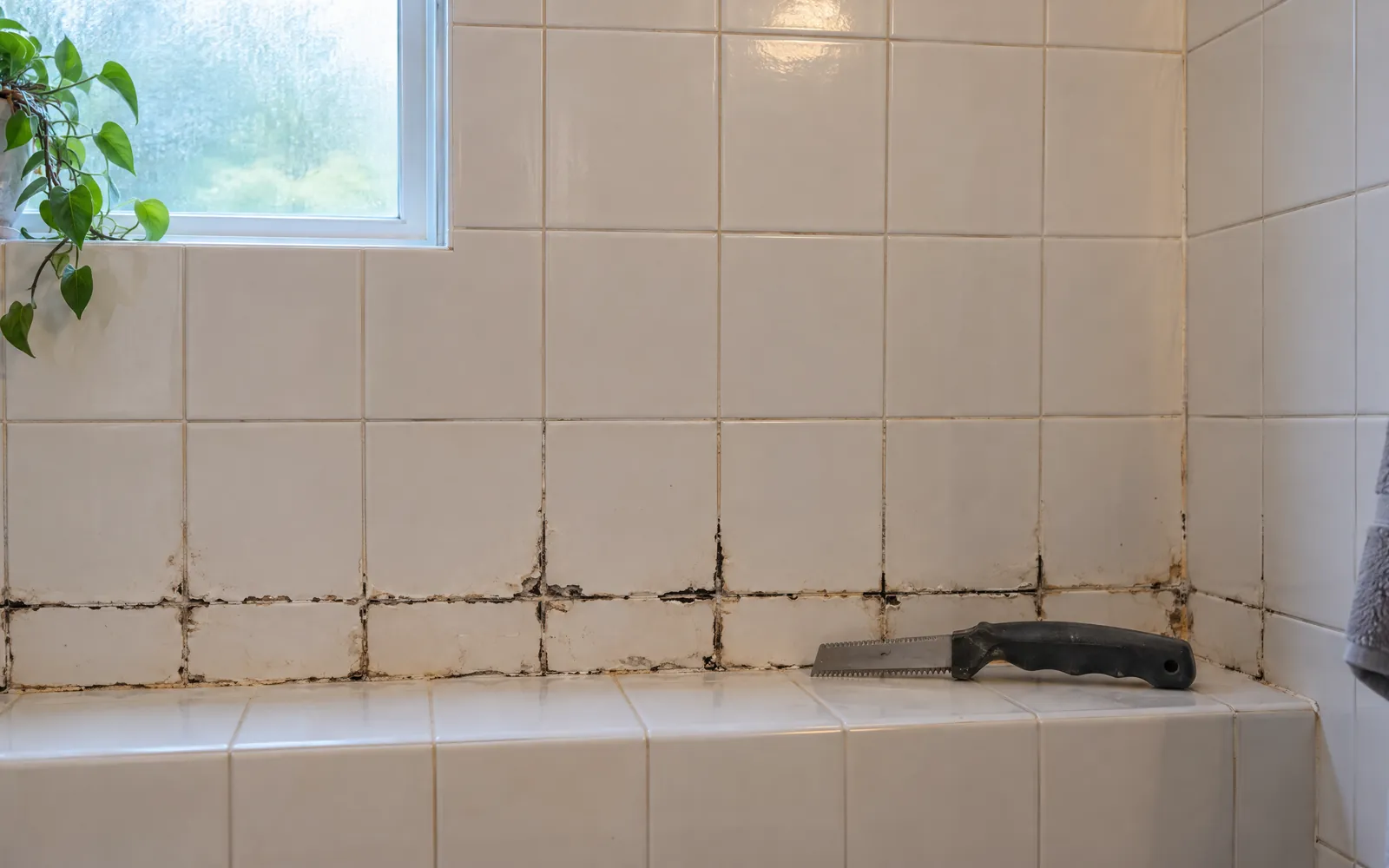
Grout is the first part of a tile shower to wear out. When it cracks, the question is simple: is the grout the problem, or is it a sign of a bigger one?
Tile and grout do not keep water out on their own. Schluter, which makes shower membranes, says tile and grout are not inherently waterproof and that the membrane behind them is what stops water. So cracked grout lets more water reach that layer, and in an older shower that layer may already be weak.
Signs the grout itself is failing
These point to grout that is worn out. On their own, they are a regrout job.
- Hairline cracks in a few joints here and there, not in one long line
- Grout that feels sandy or powdery when you scratch it with a key
- Dark stains or mildew that come back a few days after you clean
- Low spots or gaps where grout has washed out of the joint
- Cracks only in the corners and along the tub, where the tile changes direction
That last one is often the wrong material, not failed grout. Corners and the joint where tile meets the tub move a little every day, so they get flexible silicone. My guide on recaulking tubs and showers covers that joint.
Signs water is already behind the tile
These mean new grout would only cover up the problem. Check for them before you buy grout.
- A tile that moves when you push it, or sounds hollow when you tap it with a screwdriver handle
- Grout that cracks again in the same place a few months after a repair
- A wall that gives or feels soft when you press it beside the shower
- Peeling paint, stains or a soft spot on the other side of the wall or on the ceiling below
- A musty smell that stays after the shower has dried
My guide to water damage warning signs covers the other places a shower leak shows up in a house.
Should you regrout or retile a shower?
Regrout when the tiles are tight, the wall is solid and the cracks are scattered. It is a fraction of the work of retiling.
Retile, or at least open the wall, when tiles are loose in a patch or the wall flexes. That usually means the board behind the tile has been wet for a while. A single loose tile on a sound wall can often be reset. A patch of them is different. The only way to know is to pull one tile and look at what is behind it. In a house built before 1990, get that wall tested before anyone cuts into it, as I explain in asbestos in drywall in BC.
Every job I take gets a written scope before I start, so the price is agreed in advance and the list stays the list.
Want me to take this one on? My page on tile and grout repair covers what the visit includes, what I hand off, and how I price it.
How regrouting works
The old grout comes out with a grout saw or an oscillating tool, taking care not to chip the tile edges. New grout needs depth to hold. Mapei's data sheets ask for the joint to be clean and open to two thirds of the tile's depth before grout goes in.
New grout is packed in and the tile is sponged clean. Corners and the tub line get silicone once it cures.
Sanded, unsanded or epoxy grout?
The width of your grout joints decides most of it. Mapei's Keracolor U unsanded grout is made for joints from 1/16 to 1/8 inch (1.5 to 3 mm). Mapei says not to use it in wider joints. Its Keracolor S sanded grout covers joints from 1/8 to 5/8 inch (3 to 16 mm), and Mapei says not to use it in narrower ones.
Mapei warns that some glazed tiles, marble and granite can be scratched or stained by sanded or coloured grout, so test on a spare tile first. Both of these grouts want the room between 10 and 38°C while you work. Mapei also says curing takes longer below 16°C or when humidity is over 70%. In a Lower Mainland bathroom in winter, that means heat on and the fan running.
Epoxy grout is the tougher option. Mapei's Kerapoxy CQ fills joints from 1/16 to 3/8 inch (1.5 to 10 mm), resists stains and needs no sealer. It is harder to work with than cement grout. Mapei asks for the tile and wall to be between 16 and 32°C while grouting and for 72 hours after.
Does shower grout need to be sealed?
It depends on the grout. Mapei says sealing is not required for its Keracolor grouts, though a penetrating sealer can still be applied. It also says the grout must cure for 21 days before regular cleaning. Epoxy needs no sealer at all. For any other brand, the bag or data sheet says what it needs.
Sealer slows down stains and makes cleaning easier. It does not fix cracked grout or stop water that is already behind the tile. Grout sealing is part of my tile and grout repair work when the grout calls for it.
What drives the cost of regrouting a shower?
I do not publish a flat price for this. These are the things that move the number:
- The size of the shower, and tile size, since small tiles mean far more joints
- How hard the old grout is to remove without chipping tile
- Cement or epoxy grout for the new joints
- Loose tiles to reset, and new silicone at the corners and tub
- Whether the wall has to be opened once the first tile comes off
The $200 minimum per job applies, and I put the scope in writing before I start, including what happens if the wall behind turns out to be wet. I do tile and grout repair in Langley, shower tile repair in Surrey and tile repair in Abbotsford. Send a photo of the whole shower, a close one of the worst joints, and a note on any tile that sounds hollow.