
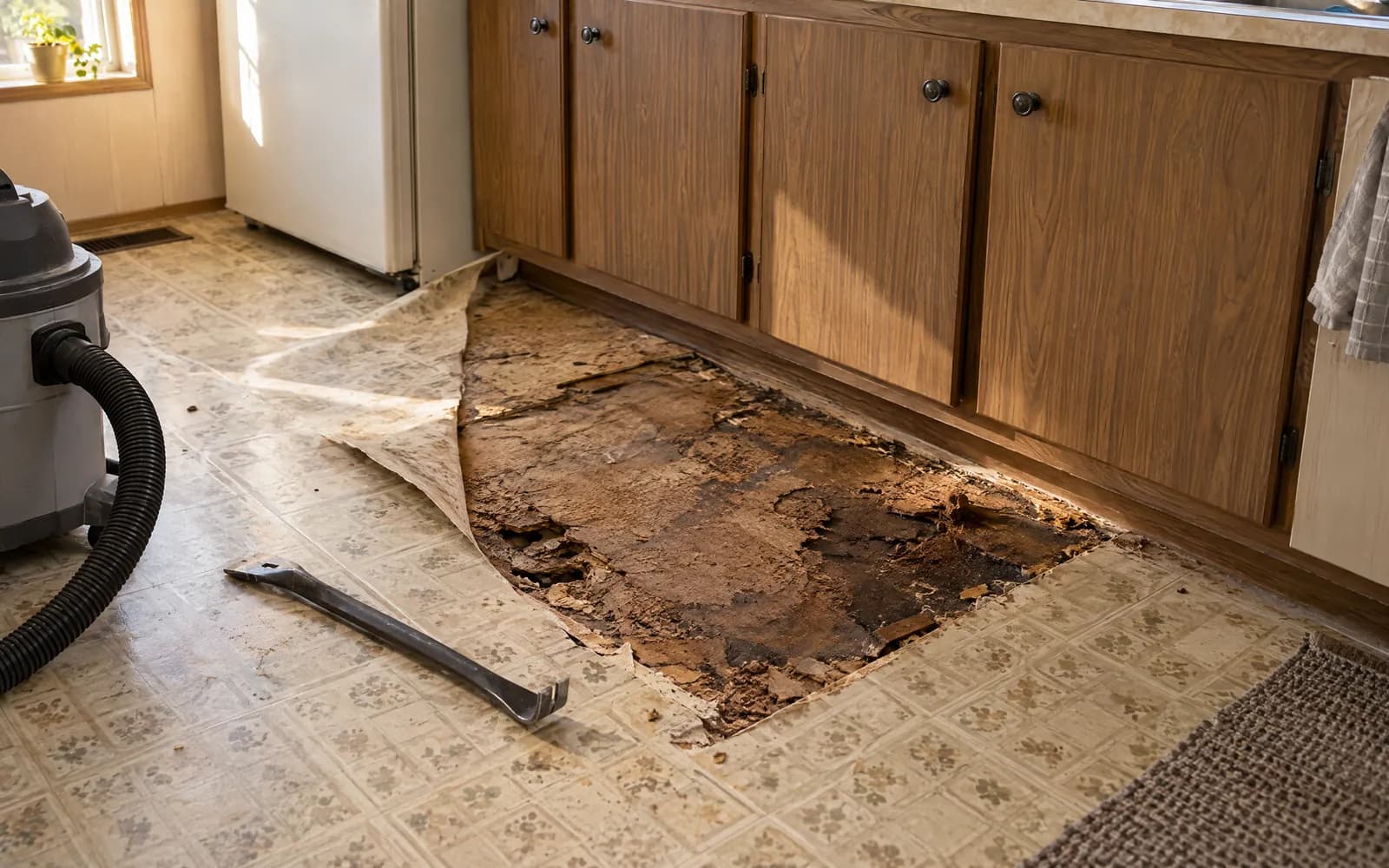
A floor that gives under your foot is easy to ignore. It starts as a small dip by the toilet or the back door. Left alone, it spreads, because the water that caused it is usually still coming. Most of my mobile home work is in Aldergrove and the rural parts of Langley and Abbotsford.
What causes soft spots in a mobile home floor?
Water, in most cases. The floor in a manufactured home is a layer of wood panel, called decking, laid over the floor joists. Pressed-wood panels like particleboard swell when they get wet. The US Forest Products Laboratory notes that part of that swelling stays after the board dries. So a soft spot rarely firms up on its own. The water usually comes from one of these:
- A toilet with a failing seal at the base, where a slow, hidden drip leaves a soft ring around the toilet.
- The tub or shower, where water gets past worn caulking or a cracked surround and runs down behind it.
- The kitchen sink, dishwasher or washer, from a slow drip at a supply line or drain.
- Exterior doors, where rain gets in under a worn threshold.
- Roof or window leaks that run down inside a wall and soak the floor from the edge.
Worn caulking is the cheapest to catch early. See re-caulking a tub or shower.
A soft spot with no fixture nearby can come from below. Many mobile homes have a sheet closing in the underside of the floor, often called the belly or bottom board. If it tears, the insulation above can sag and get damp. A floor that feels bouncy across a whole room may be a joist or support problem instead.
How do you find where the water is coming from?
Press the floor around the toilet, the tub and the sink base. Open the cabinet under the sink and look for stains, swelling or a musty smell. Check the threshold of any nearby door. If you can safely see under the home, look for a wet patch or a sag in the belly.
Fix the source before the floor, because a new patch over a live leak goes soft again. A leaking supply or drain line goes to a licensed plumber. My guide on what a handyman can legally do in BC shows where that line sits. For other signs of hidden water, see water damage warning signs.
Can a soft mobile home floor be repaired without replacing it?
Usually, yes. The soft section is cut out back to firm decking, and a new piece is fitted and fastened to the joists. Then new flooring goes down on top, or the old flooring goes back if it lifts in one piece.
The cut is often wider than the part that feels soft, because water travels through the panel. The joists under an old leak get checked too. A wet or damaged joist changes the job, and I tell you in writing before I go further.
Floor repair is part of my mobile home repair work. I ask for photos first, because floors vary a lot from one home to the next.
Who pays for repairs in a BC manufactured home park?
If you own your home and rent the site in a park, BC's Manufactured Home Park Tenancy Act applies. The Province sets out the split on gov.bc.ca: tenants are responsible for repairs to their manufactured home, and landlords are responsible for repairs to the park site. A soft floor inside your home is your repair.
Section 26 of the Act says the landlord must keep the park in a reasonable state of repair. You must keep your site clean and sanitary and repair damage you or your guests cause to the site or common areas. Reasonable wear and tear is not yours to fix.
Section 27 covers emergency repairs in the park, such as major pipe leaks, damaged or blocked water or sewer pipes, and the electrical systems. The park must give you a contact for them. The Province says the landlord must pay you back for one if you tried that contact at least twice, allowed a reasonable time, and gave the landlord a written account with receipts.
Under section 32, the park committee, or the landlord if there is none, can set rules for how the park runs. Read yours before booking work on the outside of the home or the site. The Residential Tenancy Branch handles disputes under this Act. If you rent the home itself rather than just the site, ask the Branch which rules cover you. The rules for a rented house or apartment are in landlord and tenant repair responsibilities in BC.
Every job I take gets a written scope before I start, so the price is agreed in advance and the list stays the list.
Want me to take this one on? My page on mobile home repair covers what the visit includes, what I hand off, and how I price it.
When is a soft floor a levelling or frame problem instead?
Doors that stick all through the home, gaps at the tops of wall panels, or a floor that slopes across a room can point to the home shifting on its supports.
Relevelling a home is specialist work that needs the right jacks. I refer it out, along with any structural repair to the frame and anything to do with gas or the furnace. Once the home is level and the leak is fixed, the floor repair is the part I handle.
What does mobile home floor repair cost?
I publish one price: the $200 minimum per job. Every floor is quoted from photos, and these are the things that move the rest:
- How big the soft area turns out to be once it is opened up.
- The flooring on top, whether sheet vinyl, laminate, carpet or tile, and whether it can be saved.
- What sits on the spot: a toilet, vanity, cabinets or appliances that must come out and go back.
- Whether the joists underneath need work too.
- Whether the leak is already fixed, or a plumber has to come first.
See mobile home repair in Aldergrove, mobile home repair in Langley or mobile home repair in Abbotsford for how I handle it in each town.