
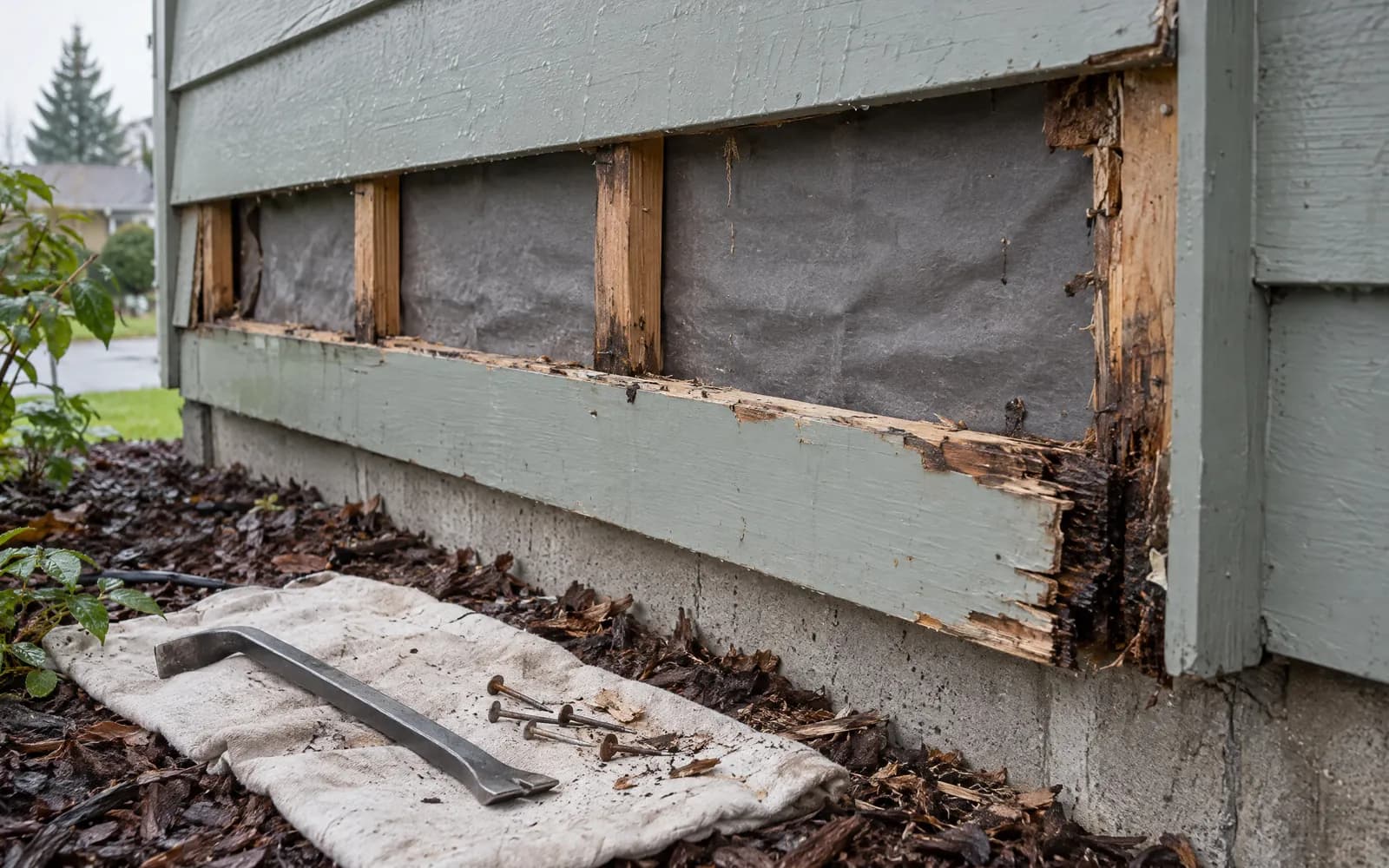
The bottom course of siding takes the worst of our weather. On a Lower Mainland house it can stay damp from October to April. By the time the paint peels or a board feels soft, water has usually been getting in for a while.
Why does siding rot at the bottom first?
Water always ends up at the bottom of a wall. Rain runs down the face of the siding and collects at the lowest edge, and the ground adds more from below. These are the causes I look for first:
- Siding that sits too close to soil, gravel or a patio, so the end grain wicks water up
- Garden beds, bark mulch or firewood piled against the wall, holding moisture on the wood for weeks
- Rain splashing back off a hard surface, or a downspout that empties right at the wall
- Cut ends that were never primed or painted, so the board drinks water through its end
- Failed caulk or missing flashing at a corner, window or deck, letting water get behind the boards
- A sprinkler that soaks the same patch of wall all summer
A repair only lasts if the cause gets dealt with too. A new board set back against wet soil will rot the same way the old one did. If an overflowing gutter is part of it, that piece goes to a gutter company, since I do not take gutter work.
Every job I take gets a written scope before I start, so the price is agreed in advance and the list stays the list.
Want me to take this one on? My page on siding and wood rot repair covers what the visit includes, what I hand off, and how I price it.
Does cedar or fibre cement siding rot?
Cedar holds up well, but it is still wood. The Western Red Cedar Lumber Association says cedar lasts for decades when it is properly finished and maintained. It also says cedar that sits in long contact with the ground should be treated with a wood preservative.
Fibre cement is a different material. James Hardie says its siding resists damage from moisture. The wood trim, sheathing and framing around and behind it can still rot if water gets in. So a soft spot at the base of a fibre cement wall usually means water is getting behind the siding.
How much gap should siding have above the ground?
Siding makers set this gap in their instructions. It keeps the bottom edge out of splash and wicking range. James Hardie's quick-start installation guide asks for at least 8 inches between its siding and the ground in Canada. It asks for at least 2 inches above a deck, path, steps or a roof. The same guide says the install must also meet local building code.
For cedar, the Western Red Cedar Lumber Association says trim at the base of a wall, like a skirt board, must be at least 6 inches above grade. It asks for a 2 inch gap where siding meets a roof or a deck.
On many older houses the ground has crept up over the years. A new garden bed, a load of gravel or a raised patio buries the gap and nobody notices. Pulling the soil and mulch back is the cheapest rot repair there is. Where a deck butts against the wall, the siding and the deck ledger share the same wet corner, and my guide on deck repair or replacement covers what to check there.
Can a few rotted boards be replaced without re-siding?
Usually, yes. Rot at the bottom of a wall tends to stay in the lowest courses, the corner boards and the trim around doors and windows. I cut out the soft boards and keep going until I hit sound wood, however far that runs. New boards go in, the new material is primed and sealed, and the joints get caulked and flashed where they need it. That is the core of my siding and wood rot repair work.
Expect the match to be close, but not perfect. Profiles change and mills drop lines, and the old boards beside the repair have had years of weather. Paint is what makes a repair disappear. I tell you up front where it will still show before paint. Rot at the window trim often starts inside, and my guide on window sill rot covers that side.
What if the rot runs past the siding?
The board you can see is often only the edge of the damage. Once a bottom course is off, I look at the building paper and the sheathing behind it. If the sheathing is soft, the job grows. My written scope says ahead of time what happens if the rot runs further, so nothing gets invented on the day.
Some jobs belong to another trade. If rot has reached the studs or the bottom plate of the wall, that is framing, and a contractor should handle it. If water is getting in across a whole wall, or the house has leaked through the siding in more than one place, call a building envelope consultant first. They find out why the wall is failing before anyone rebuilds it. I will tell you which of these you have before any work starts.
Rot behind siding often shows up indoors first, as a stain, swollen baseboard or musty smell along the bottom of an outside wall. My guide to water damage warning signs covers those inside signs.
What does it cost to repair rotted siding?
There is no flat price, because nobody knows how far rot runs until the board is off. These are the things that move the number:
- How many boards and courses are soft, and whether corner or window trim is part of it
- What turns up behind the siding once it is open: dry paper and sound sheathing, or soft wood
- The siding type and profile, and how hard a match is to find
- Height and access, since a second-storey wall needs ladders or staging
- Priming, sealing, caulking and flashing the new material so it lasts
I quote what I can see in writing, and the scope spells out what happens if more turns up. The $200 minimum per job applies, so a few rotted boards and other outside fixes are best done in one visit. I do siding and wood rot repair in Langley, wood rot repair in Surrey and siding repair in White Rock. Send photos of the bottom boards, the corners and the ground below them through the quote form.
Walk the base of the house before the heavy rain settles in. My fall home maintenance checklist puts that walk with the other jobs worth doing before winter.