
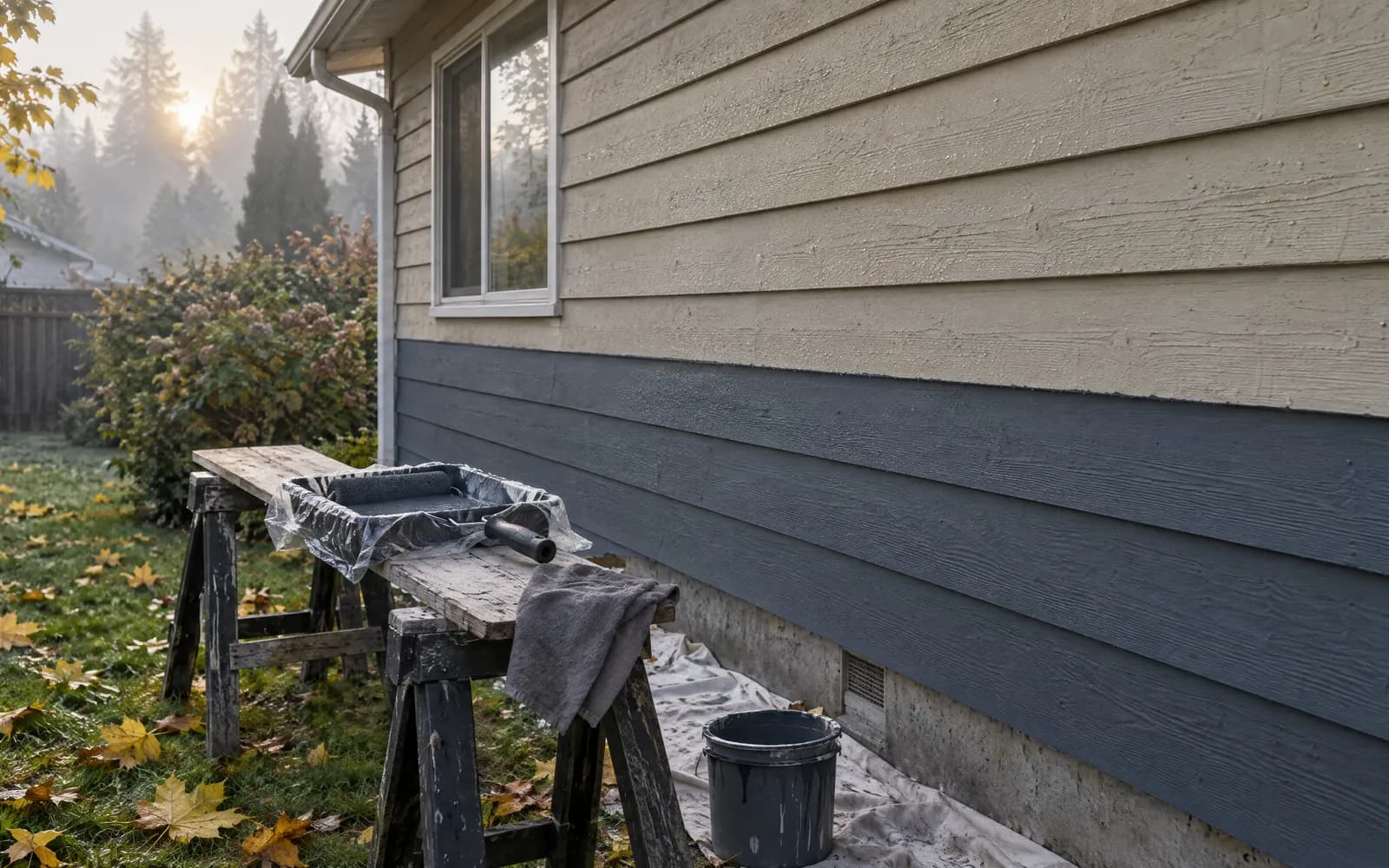
Most people think fall painting stops when it gets cold. On this coast, it usually stops because it gets wet. Our fall days are often mild enough for paint. What they lack is a dry wall, a dry afternoon and a dry night after the paint goes on.
How cold is too cold to paint outside?
The answer is on the data sheet for the paint in the can. Here are four from the makers' own sheets. They are examples, and I am not recommending one over another:
- Benjamin Moore Aura Exterior Flat: not below 35°F (1.7°C), air or surface
- Sherwin-Williams Emerald Exterior Acrylic Satin: above 35°F (1.7°C), and not when it may drop below that within 48 hours
- General Paint Breeze 70-010: can be applied at 2°C
- Cloverdale WeatherOne CoverCoat Flat: as low as 5°C (41°F)
You can read them for yourself: the Aura Exterior data sheet, the Emerald Exterior data sheet, the Breeze product page and the CoverCoat product page.
Two catches. First, the number is for the surface as well as the air. Sherwin-Williams points out that when the air is at 35°F, the wall may be colder. Siding on a north wall or in shade stays cold longer than the thermometer on your porch. Second, the primer has its own limit. The same Emerald sheet says standard latex primers cannot be used below 50°F (10°C). Bare wood, patches and new trim often need primer, so the coldest step decides the day.
Can you paint outside when it is damp?
Not on a wet surface. Benjamin Moore's guide to painting temperatures gives the industry standard: paint on a surface that is more than 5°F (about 3°C) above the dew point. The dew point is the temperature where water starts to condense. Sherwin-Williams asks for the same margin on its Emerald sheet.
In fall, that rules out the early morning. Environment Canada's climate normals for Abbotsford Airport put the average 6 a.m. humidity at 89% in September and 88% in October. That is why siding is often wet with dew at breakfast when it has not rained at all. Wait until the sun and air have dried the wall, and stop early enough that the paint can set up before the evening dew comes back.
Every job I take gets a written scope before I start, so the price is agreed in advance and the list stays the list.
Want me to take this one on? My page on exterior painting covers what the visit includes, what I hand off, and how I price it.
How long does exterior paint need before it rains?
Longer when it is cool. Sherwin-Williams says to avoid using Emerald Exterior if rain or snow is expected within 2 to 3 hours. Its sheet also shows how much the cold slows things down. Above 45°F (about 7°C), the recoat time is 4 hours. Between 35 and 45°F, it is 24 to 48 hours.
Benjamin Moore's Aura sheet gives 1 hour to touch and 4 hours to recoat, measured at 25°C and 50% humidity. It adds that high humidity and cool temperatures make every one of those times longer, and that the paint can be washed after two weeks. A fall day in the Fraser Valley is cooler and damper than the lab. Plan for the long end.
If rain catches you anyway, Benjamin Moore says to stop, wait until the rain ends and the surface is dry, and leave any bubbles in the fresh paint alone. Once it has dried, the spot can be checked and touched up.
When is it too late to paint outside here?
The same Abbotsford normals tell the story. From 1981 to 2010, September averaged about 10 days with rain. October averaged about 16 and November about 20. The average daily low dropped from 9.3°C in September to 5.9°C in October and 2.7°C in November. These are averages, not a forecast, and your year will differ.
So September and early October leave the most room for dry days in a row, and November leaves the least. A full repaint of a wall wants several of those days in a row. A touch-up on a door or a few trim boards only needs one.
What to do if you missed the window
Protect the wood through the winter and save the big job for summer. Bare wood is what gets hurt, so cover it first:
- Spot-prime and paint any bare wood on a dry day, even if the rest of the wall waits
- Caulk open joints at trim, windows and doors, within the temperature on the tube
- Scrape loose paint so water cannot sit behind it
- Look closely at the lowest boards and window sills, where rot starts
- Book the full repaint for the dry months
Soft wood under the peeling paint is a repair before it is a paint job, and my guide on siding rotting at the bottom covers it. For the paint itself, what makes a paint job last covers prep and paint quality. My summer home maintenance checklist lists the exterior jobs that belong in the dry season.
Caulking, sanding and priming come with my exterior painting work. In fall, book with room for the date to move with the forecast. The $200 minimum per job applies. I paint in Langley, with house painting in Surrey and exterior painting in White Rock as well. Send photos of each wall you want painted and any bare or soft spots.