
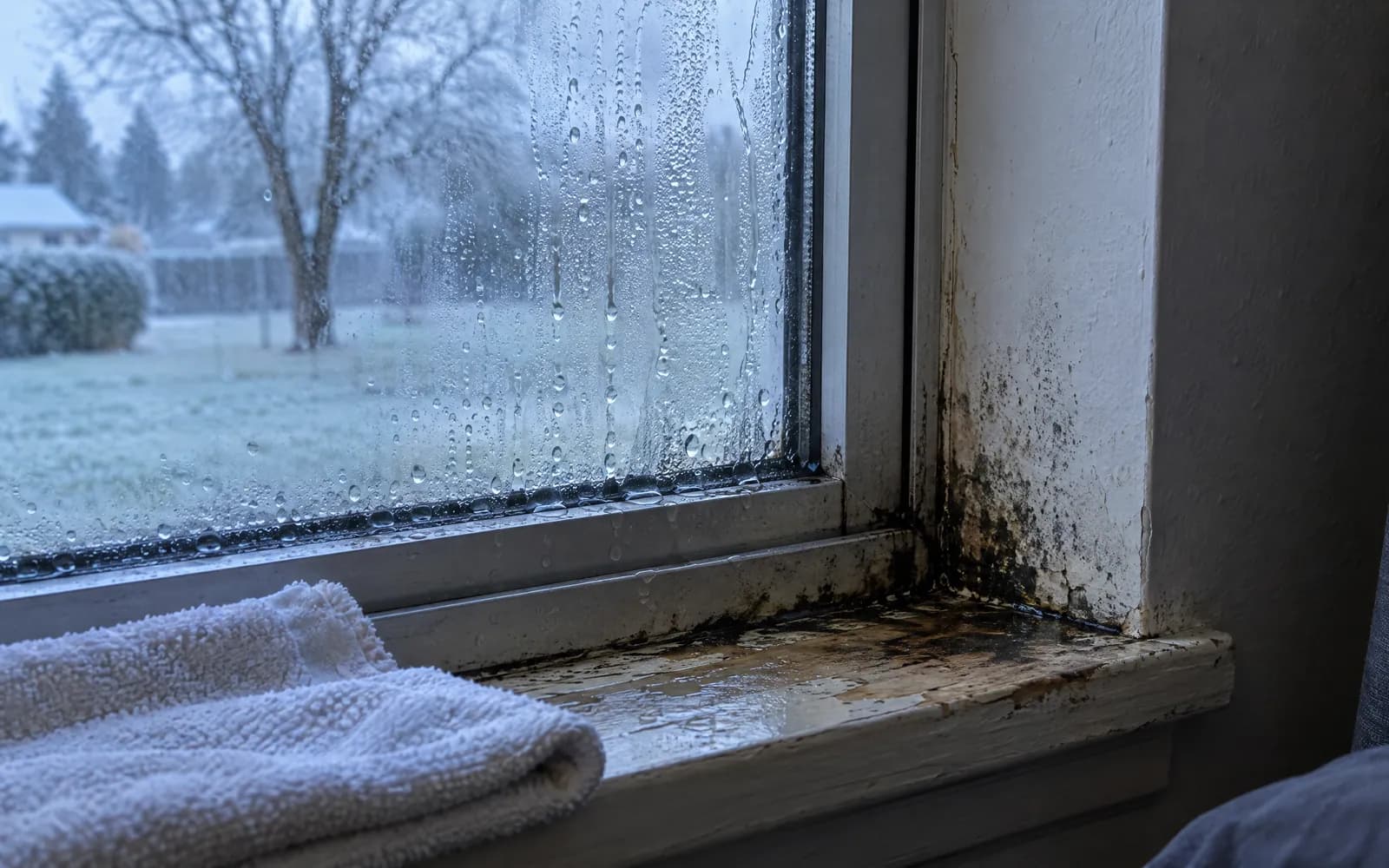
In a Lower Mainland winter, a lot of houses wake up to the same thing. Water pools on the sills, black spots show up in the corners of the frame, and paint starts lifting off the wood. Most of it starts as condensation, and most of it can be kept small if you catch it early.
Why do windows get condensation inside in a Lower Mainland winter?
Indoor air carries water from cooking, showers, laundry, plants and breathing. When that warm air touches cold glass, it cools and lets go of the water it was carrying. Our winters are mild but long and wet, so the glass stays cold and the windows stay shut for months. Older windows with single glass or metal frames run colder, so they often drip first.
Health Canada names condensation on cold surfaces like windows as one source of indoor moisture. It lists kitchen and bathroom fans that are not used, not working or not vented outside as another. More people, more showers and more cooking in a closed-up house all add to it.
Every job I take gets a written scope before I start, so the price is agreed in advance and the list stays the list.
Want me to take this one on? My page on window trim and wood rot repair covers what the visit includes, what I hand off, and how I price it.
How do you stop condensation on windows?
The coldest mornings may still fog up. You can cut the rest down, and Health Canada's guide to moisture and mould gives this list for condensation on windows, frames and sills:
- Keep indoor relative humidity between 30% and 50%, with a dehumidifier if you need one
- Use the bathroom fan and the kitchen range hood
- Keep curtains and blinds open so warm air can reach the glass
- Keep heating vents and baseboard heaters clear of furniture, and leave inside doors open
- Dry the window frames and sills every day
- Unplug and put away humidifiers
- Fix any leaks promptly
A small humidity gauge from a hardware store shows you where your house sits. Check it on a cold morning, when the windows are at their worst.
Is mould on a window sill dangerous?
Health Canada says indoor mould growth may pose a health hazard. Infants, children, seniors, pregnant people and people with asthma are at greater risk. A few spots on a window sill are common in a damp winter, and Health Canada treats a small area as something you can clean yourself with the right steps and protective gear. It calls an area small when there are three patches or fewer and the total is under one square metre.
For a hard surface like a sill, it says to scrub with a cloth and an unscented soap solution, then dry it completely and quickly. It also says not to use bleach. If mould comes back after cleaning, or covers a large area, Health Canada says to get professional help. At that size, a mould remediation company is the right call, and I come in after them to repair the wood and drywall.
Renting? The Province lists dealing with minor mould on windowsills, tubs and showers as a tenant's job, and says landlords should fix water damage quickly. My guide to landlord and tenant repair responsibilities in BC covers the rest of that split.
When has a wet sill turned into rot?
Wet paint and a few black spots are a surface problem. Rot is when the wood itself has gone soft. These are the signs to look for:
- Paint on the sill that bubbles, cracks or peels, and comes back after you repaint
- Wood that is dark, grey or black under the paint
- A screwdriver that sinks in with light pressure
- Joints in the sill or trim that have opened up
- Stains or soft drywall under the window
Press the corners first, where the water sits longest. If the wood is sound, clean it, dry it, prime it and repaint. If it is soft, paint only hides it for a season. Health Canada says materials damaged by mould must be physically removed, and rotted trim is the same.
Check whether the water is really condensation. Condensation fogs the whole pane and is worst on cold mornings. A leak shows up after rain, often at a corner, and can stain the wall below. My guide to water damage warning signs covers the leak side.
Can a rotted interior sill be replaced without new windows?
Usually, yes. Two different parts get called the sill. The bottom of the window frame is part of the window itself. The wider board inside, where plants and cups end up, is often called the stool, and it is trim. A rotted stool or casing can be cut out and replaced without touching the window.
That is window trim rot repair, and it is work I do. I cut the soft wood back to sound wood, fit a new piece, then prime, caulk and fill it ready for paint. I take it on as window trim and wood rot repair in Surrey and wood rot repair in Langley, and new casing fits in with trim carpentry in Abbotsford. The full scope is on my siding and wood rot repair page.
Some window problems belong to someone else. If the rot is in the window frame itself, the glass has fogged between the panes, or water is getting in around the outside of the window, call a window company. Replacing windows is not work I do. If the wall around the window is wet too, a building envelope consultant is the right first call. Send photos of the sill, the corners and the wall below through the quote form and I will tell you which of these you have.